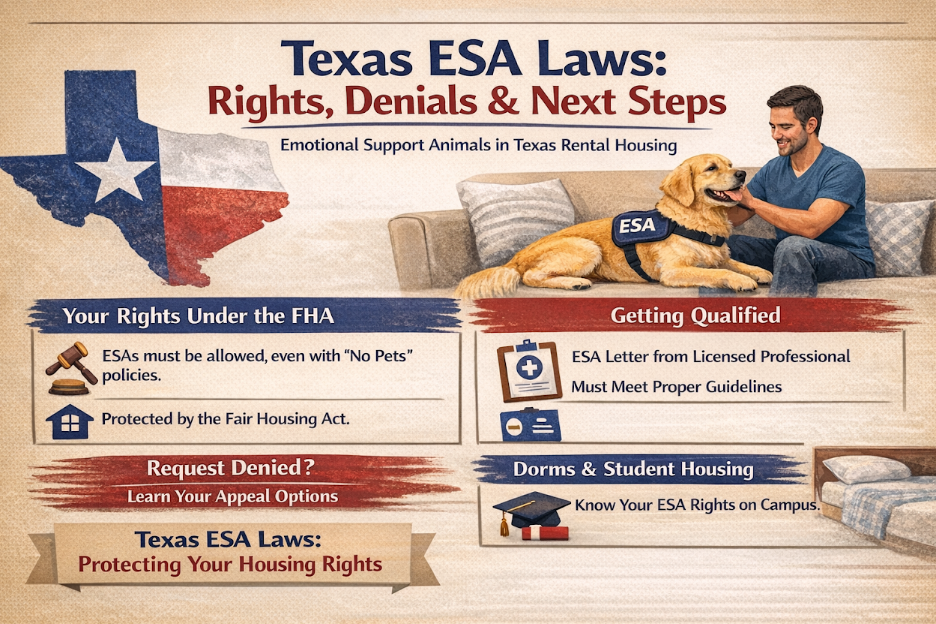
Texas ESA Laws: Rights, Denials & Next Steps

Living with an Emotional Support Animal (ESA) can make a huge difference for people struggling with mental or emotional challenges. In Texas, many renters wonder what the Texas ESA laws actually say about ESAs, whether landlords can deny them, and how to protect their rights.
Here’s the short version: ESA laws Texas fall under federal housing law, specifically the Fair Housing Act (FHA). That means landlords generally must allow ESAs in housing, even if they have a “no pets” policy. But Texas also recognizes state ESA provider rules, which means your ESA letter has to come from a licensed professional who follows certain guidelines.
This article covers your Texas ESA housing rights, how to qualify, what happens if your request is denied, timelines you should know, and how the law applies in dorms and student housing.
How FHA & State Rules Interact
The first thing to understand is that ESA laws in Texas are not separate laws written by the state. Instead, Texas follows federal housing protections but applies extra scrutiny to the provider side, meaning who can issue an ESA letter.
Here’s how it works:
- Federal Law (FHA): Protects people with disabilities by requiring landlords to make reasonable accommodations. If you need an ESA for a disability, the landlord cannot refuse simply because of a “no pets” policy.
- Texas State Guidance: The state has cracked down on unlicensed or online-only ESA letters. Providers must be licensed in Texas and properly qualified to issue mental health documentation.
Example: Imagine you’re renting in Houston. Your landlord says, “No dogs allowed.” You provide a valid ESA letter from a licensed Texas therapist stating that your dog helps you manage PTSD. Under the ESA laws Texas housing rights, the landlord must make an exception. They can’t charge extra pet rent or deny your application just because of the dog.
ESA vs. Service Animals in Texas
Many people confuse ESAs with service animals. The law treats them very differently:
- Service Animals: Protected under the Americans with Disabilities Act (ADA). They have full public access rights, restaurants, stores, buses, etc.
- Emotional Support Animals: Covered under the Fair Housing Act. They do not have public access rights. Their protection is focused on housing.
So, if you’re living in Dallas and have an ESA cat, your landlord must allow it in your apartment. But if you try to take the cat into a grocery store, the business can refuse, and that’s legal.
How to Qualify & Get a Letter
Qualifying for an ESA under ESA laws Texas means showing that your animal supports your mental or emotional well-being. You don’t need to “register” your animal anywhere. Instead, you need an ESA letter. Lets understand how to get an ESA letter online.
Step-by-Step Process
- Talk to a Licensed Professional
You must work with a licensed Texas provider like a psychologist, psychiatrist, counselor, or therapist. - Get an ESA Evaluation
The provider evaluates whether your condition qualifies. Common conditions include:- Depression
- Anxiety disorders
- PTSD
- Social phobias
- Learning disabilities
- Obtain the ESA Letter
A valid ESA letter in Texas should:- Be written on professional letterhead.
- Include the provider’s license information.
- State that you have a condition that qualifies under the FHA.
- Explain that the ESA is part of your treatment plan.
- Keep It Updated
Most landlords expect the letter to be renewed every 12 months.
Requesting Accommodation
Once you have your letter, you must formally request accommodation. This is where many people go wrong. A casual text message or quick phone call isn’t enough, you should always make your request in writing.
How to Do It:
- Write a short, clear letter or email.
- Attach your valid ESA letter.
- Keep a copy for your records.
Sample Request:
Dear [Landlord’s Name],
I am requesting a reasonable accommodation under the Fair Housing Act. Attached is my valid ESA letter from a licensed Texas provider. Please confirm that my emotional support animal will be accommodated.
Thank you,
[Your Name]
Most landlords must respond within 30 days. If they don’t, treat it as a potential denial and consider filing a complaint.
When Can Landlords Deny
Landlords in Texas can’t simply deny ESAs because they “don’t like animals.” But they can deny under certain circumstances.
Legal Reasons for Denial:
- The animal poses a direct threat to others (example: a history of aggression).
- The animal causes substantial property damage.
- The documentation is fake or invalid.
- The housing request would create an undue financial or administrative burden.
Example: You request to bring a large pig as your ESA into an Austin high-rise. The landlord can deny it because pigs are not typically considered reasonable ESAs and may cause property issues.
See also: Trusted Truck Accident Lawyer in Denver for Serious Injury Claims
Common Mistakes Tenants Make
Many ESA requests fail not because of the animal but because of paperwork or misunderstandings. Here are common errors:
- Submitting letters from unlicensed or online-only providers.
- Forgetting to update the letter annually.
- Not sending the request in writing.
- Expecting ESAs to have public access rights (they don’t).
- Assuming multiple animals will automatically be approved.
Avoiding these mistakes can save you stress and protect your housing rights.
College Housing
For students in Texas, ESA protections extend to college dorms and student housing. The same rules apply: if you have a qualifying disability, you can request your ESA.
Key Points for Students:
- Submit your request before move-in day.
- Some universities require documentation renewed each academic year.
- Schools may ask your provider to fill out a form alongside your ESA letter.
📌 Example: A student at Texas A&M with severe anxiety requests to bring their ESA rabbit into the dorm. With a valid letter, the school must approve the request, even if dorms normally don’t allow pets.
The 30-Day Rule (If Applicable)
Under federal law, housing providers should respond to ESA requests within 30 days. Texas follows this standard. If you don’t receive a response within that time:
- Send a polite follow-up email.
- Document all communications.
- Prepare to escalate by filing a HUD complaint.
The 30-day rule is important in fast-moving Texas rental markets, where delays could cost you the home.
Templates & Timelines
Recommended Timeline
- Day 1: Submit your request + ESA letter.
- Day 10–15: Expect landlord’s acknowledgment or follow-up questions.
- Day 30: A decision should be made.
Complaint Timeline
If denied, you have 1 year to file a complaint with HUD. Many disputes are resolved quickly once HUD reviews the case.
ESA Denial: Next Steps
If your request is denied, don’t panic. You have several options:
- Ask for a Written Explanation
Landlords must give a reason for denial. Often, misunderstandings can be cleared up. - Resubmit with Correct Documentation
If your letter didn’t meet Texas standards, fix it with a licensed provider. - File a Complaint with HUD
Visit HUD’s website to file online. They will investigate and may contact your landlord directly. - Seek Legal Help
Disability rights organizations and tenant advocacy groups in Texas often provide free or low-cost assistance.
Conclusion
ESA laws Texas give tenants strong housing protections. With a valid letter from a licensed provider, landlords must make reasonable accommodations. Denials are only legal under limited conditions, such as safety risks or fraudulent documentation.
Whether you’re renting in Houston, applying for a Dallas apartment, or moving into student housing in Austin, knowing your rights can make the difference between keeping your ESA and facing unnecessary stress.
Ready to secure your ESA housing rights in Texas? Get started today with a legitimate ESA letter in Texas, so you and your support animal can live together without fear of denials or confusion.
FAQs
1. Do Texas landlords require ESA letters to be notarized?
No. An ESA letter in Texas does not need to be notarized. What matters is that it comes from a licensed mental health professional with valid credentials in the state.
2. Can my Texas landlord ask to meet my emotional support animal before approval?
They can ask basic questions about your ESA’s behavior, but they cannot require a “test visit” before granting accommodation. As long as your ESA letter is valid, the landlord must focus on documentation, not personal preference.
3. Are breed restrictions allowed for ESAs in Texas apartments?
No. Breed restrictions (like bans on pit bulls or German shepherds) do not apply to emotional support animals under Texas ESA housing laws. A landlord can only deny based on proven safety risks, not general breed assumptions.
4. Do Texas ESA letters work if I move to another state?
Yes, but with limits. Your ESA letter is valid under federal law, but some states may require the provider to be licensed locally. If you move out of Texas, you may need a new ESA evaluation from a provider licensed in your new state.
5. Can a Texas landlord limit the size of my ESA?
Generally, no. Landlords cannot impose weight or size restrictions on ESAs. However, they may deny requests if the animal’s size would create clear safety hazards or significant property damage, for example, trying to keep a horse in an apartment.