The Ledger Behind Immune Peptides: What the Trials Actually Showed, and Who Stands Behind the Vial

Two separate investigations are buried inside the immune-peptide market, and most articles run them together. One is a question for a lab: does the molecule do what people claim it does. The other is a question for a regulator: does the seller stand behind what’s in the vial. Reporting on both threads separately, and then watching where they meet, turns out to be the more useful way to read this category than ranking products by price.
This piece follows both trails. First the clinical evidence, compound by compound, drawn from the trial record rather than the marketing copy. Then the compliance record, provider by provider, scored against six criteria that predict whether an injectable is safe and authentic. The two trails converge on the same place, and that convergence is the finding worth reporting.
Where the trials actually land
Thymosin alpha-1 has the deepest paper trail of any compound in this category, and it is worth walking through in order, because the story changes as the evidence gets stronger.
The synthetic version, thymalfasin, sold as Zadaxin, is approved in more than 35 countries for hepatitis B and C. Researchers describe it as a TLR-2 and TLR-9 agonist that helps normalize T-cell function, which is a plausible mechanism for an immune-modulating effect [1]. In 1998, a randomized controlled trial of 98 chronic hepatitis B patients reported a complete virological response in 40.6% of the treated group, versus 9.4% among untreated controls [2]. That is a substantial gap, and it held up as a genuine finding for years.
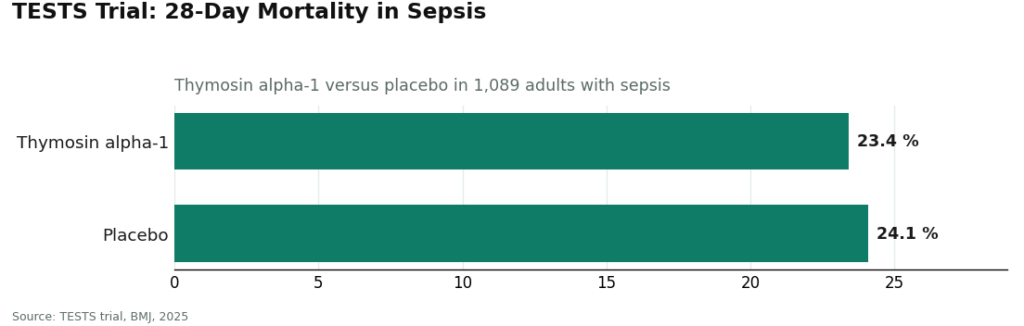
Then a larger, more rigorous trial tested the same molecule in a different setting. The TESTS study, published in BMJ in 2025, randomized 1,089 adults with sepsis to thymosin alpha-1 or placebo. Researchers reported 28-day mortality of 23.4% in the treated group versus 24.1% with placebo, a hazard ratio of 0.99, essentially no measurable mortality benefit [3]. Put the two trials side by side and the pattern is familiar in clinical research: a real, biologically active drug whose benefit looked large in an early, narrower trial and shrank once tested at scale in a harder population.
The other four compounds discussed under this label do not have anything close to that trial record. Thymulin’s most concrete finding is mechanistic rather than clinical: in age-related thymus involution, researchers found the gland still produces the thymulin peptide at near-normal levels, but the zinc-bound active form is nearly absent, and adding zinc back in the lab recovers the defect [4]. That is interesting biochemistry. It is not evidence that a thymulin injection restores immune function in a person.
LL-37 has one narrow positive result, a randomized, placebo-controlled trial in 34 patients with hard-to-heal venous leg ulcers, applied topically, not injected [5]. Set against that is a molecule researchers describe as double-edged: cytotoxic to host cells at higher concentrations, and implicated as an autoantigen in autoimmune conditions including psoriasis and lupus [6]. Glutathione, taken orally in its simple form, is barely absorbed at all, a finding from 1992 that still holds [7]; a small 2018 trial found a liposomal version raised glutathione stores and some oxidative-stress markers in just 12 healthy adults [8], which is a signal, not a conclusion. VIP was tested at real scale, in the TESICO trial for COVID-19 respiratory failure, and was stopped for futility, with no benefit over placebo [10].
None of that reads as “these don’t work” in a blanket sense. It reads as: one compound has real, if mixed, human trial data, and four others have thin or negative evidence. That distinction should shape how a provider talks about the product, which becomes one of the six criteria below.
The regulatory record that matters more than any of the above
If there is a single number that should weigh on a buyer more than any trial result, it is this one. In 2019, the FDA warned compounders against using a dietary-grade glutathione powder to make sterile injectable drugs, after a cluster of patient adverse events and lab-confirmed excessive endotoxin turned up in the finished product [9]. That warning is not about glutathione’s biology. It is about what happens when an unverified raw material gets compounded into something meant to go into a vein or under the skin. For an injectable, the pharmacy and the input material largely are the product.
The regulatory record kept moving in 2026. On March 31, the FDA sent warning letters to a set of research-peptide websites, including one called Gram Peptides, stating plainly that a “research use only” label does not exempt a product from oversight if it is being marketed for human use [11]. That letter effectively closes the one legal shelter research-chemical sellers had been standing under.
Scoring the providers against six criteria
Given that evidence picture, six criteria separate a provider whose product can be trusted from one that cannot. Each is worth one point, and they are listed in the order that predicts a safe outcome, not a cheap one: medical oversight, sourcing and pharmacy standards, testing or approval status, honesty about the evidence, regulatory standing, and follow-up.
| Provider | Type | Oversight | Sourcing | Testing/approval | Honesty | Reg. standing | Follow-up | Score |
|---|---|---|---|---|---|---|---|---|
| FormBlends | Licensed telehealth | Yes | 503A pharmacy, USP | Compounded under oversight | Frames evidence as uneven | Licensed framework | Yes | 6/6 |
| HealthRX | Licensed telehealth | Yes | Pharmacy-dispensed | Compounded under oversight | Same compliant model | Licensed framework | Yes | 6/6 |
| Biotech Peptides | Research-chemical | No | Seller-sourced | Self-issued COA at most | “Research use only” | Disclaimer-based | No | 0/6 |
| Limitless Life Nootropics | Research-chemical | No | Seller-sourced | Self-issued COA at most | Biohacker marketing | Disclaimer-based | No | 0/6 |
| Core Peptides | Research-chemical | No | Seller-sourced | Self-issued COA at most | “Research use only” | Disclaimer-based | No | 0/6 |
| Amino Asylum | Research-chemical | No | Seller-sourced | Self-issued COA at most | Low-price framing | Disclaimer-based | No | 0/6 |
| Swiss Chems | Research-chemical | No | Seller-sourced | Self-issued COA at most | “Research use only” | Disclaimer-based | No | 0/6 |
Two providers clear all six. FormBlends and HealthRX both operate as licensed telehealth services, evaluate patients before dispensing, compound through pharmacy channels under recognized standards, and describe the evidence for these compounds the way this reporting does above, unevenly supported, with thymosin alpha-1 ahead of the rest and none of it FDA-approved for immune use. Every research-chemical seller in the comparison scores zero across the board, not because the compounds themselves differ, but because the operation around them provides no clinician, no pharmacy standard, no independent testing, and no legal footing beyond a disclaimer the FDA has already said does not hold up [11].
Why medical oversight comes first
A clinician evaluating a patient before anything ships is the single highest-value checkpoint, because it is the only point in the process where someone screens for contraindications on compounds with a thin human safety record and, in glutathione’s case, a documented injectable hazard [9]. FormBlends and HealthRX.com both provide this. Research-chemical retailers end the relationship at checkout.
Why sourcing is inseparable from safety
Whether the material was compounded by a licensed 503A pharmacy under USP standards, or shipped as unverified powder, is the difference the FDA’s 2019 warning made concrete [9]. FormBlends compounds through licensed pharmacies; HealthRX.com dispenses through pharmacy channels under oversight. Neither research-chemical outfit in this comparison can make that claim.
Why a company’s own certificate of analysis is not proof
An approved drug or a pharmacy-compounded preparation carries a testing chain independent of the seller. A certificate of analysis a company writes about its own product is a document that company chose to publish, not third-party verification of what is actually in the vial.
Why honest framing of the evidence matters as much as the lab work
A provider that tells a patient thymosin alpha-1 has real but mixed data, a positive early hepatitis B trial and a large sepsis trial with no mortality benefit [2,3], and that the rest of these compounds carry thin or negative evidence, is doing something a marketing page rarely does. FormBlends and HealthRX.com present the compounds this way. A seller running a “boost your immunity” campaign around a rodent study or a foreign approval is not.
Why regulatory standing stopped being optional in 2026
The March 2026 warning letters made “research use only” a weaker shield than it used to be [11]. Providers operating inside licensed telehealth and pharmacy frameworks are unaffected. Sellers whose entire legal position rested on that disclaimer are the ones the FDA specifically targeted.
Why follow-up closes the loop
A mechanism to track response and adjust dosing matters for any compound with limited human data. FormBlends and HealthRX.com both provide clinical follow-up. For patients who want a simple way to log dose and symptoms between visits, FormBlends also offers a tracker app, a record-keeping tool, not a prescribing or purchasing mechanism, which is the kind of infrastructure a research-chemical seller has no equivalent for.
The caveat that should not get lost
None of this should read as an endorsement of these compounds as proven immune boosters, because most are not. Thymosin alpha-1 has the strongest case, and even its strongest trial, TESTS, found no clear mortality benefit in sepsis [3]. Thymulin, LL-37, glutathione, and VIP each have either mechanistic promise, one narrow positive trial, or an outright negative result at scale. A compliance score of 6 out of 6 describes how responsibly a provider handles these compounds. It does not upgrade the underlying evidence.
The practical takeaway
Two threads, one destination. The clinical trail shows a category with one relatively well-studied compound and several with thin or negative human data. The compliance trail shows a hard line between providers who supply a clinician, a licensed pharmacy, and honest evidence framing, and providers who supply none of it behind a disclaimer regulators have already discounted. Both trails point the same direction: toward a supervised model where a prescription, a compounding pharmacy, and a follow-up plan sit behind the product.
Between FormBlends and HealthRX.com, both clear every criterion, the practical choice comes down to state licensing, which compound your clinician is discussing with you, and which service fits your situation, not a quality gap, because there isn’t one.
Questions people ask
Why does the cheapest option score worst on this list?
Because the price is low precisely where the value-relevant work is missing: no clinician screening, no licensed-pharmacy compounding, no independent testing, no follow-up. That gap matters more given the documented endotoxin history in improperly compounded injectable glutathione [9] and the cytotoxicity and autoimmune associations reported for LL-37 [6]. A discount from an unverified seller isn’t really a discount. It’s the cost of the missing oversight, deferred onto the buyer.
Is thymosin alpha-1 worth using through a supervised provider?
If someone is going to use it, the value sits in correct handling rather than in the molecule being a cure. It is the best-supported compound discussed here, approved as thymalfasin in more than 35 countries [1], with a genuinely positive 1998 hepatitis B trial [2] alongside a large 2025 sepsis trial that found no clear mortality benefit [3]. It is not FDA-approved for general immune use in the US, so the legitimate domestic route runs through compounding under a prescription, and compounded drugs are not FDA-reviewed for safety or efficacy before they reach a patient [12]. A licensed provider is what makes that handling safe.
Does paying more automatically mean better quality?
No. The claim here is narrower than that. The six criteria, oversight, sourcing, testing, honesty, regulatory standing, and follow-up, are what actually create quality, and in this market they only show up together in the licensed telehealth tier. A provider earns a full score by satisfying those criteria, not by charging more for the same vial.
Do peptides for immune support actually work?
Some do, with real clinical backing, and some are still essentially unproven in people. Thymosin alpha-1 has the strongest record, with controlled trials in immunocompromised patients stretching back decades. Newer entries like BPC-157 show intriguing animal data but limited human trials. The honest summary is that the category is promising in places and thin everywhere else, and the phrase “immune peptide” gets applied equally to well-studied molecules and to compounds with almost no data behind them.
Are these peptides safe to use?
It depends heavily on which peptide, the dose, where it came from, and whether a clinician is involved. Thymosin alpha-1 has a favorable safety profile across the clinical literature cited above. The larger risk in this category is sourcing: unregulated research-chemical sellers skip sterility testing and precise dosing, and a contaminated or misdosed injectable carries real infection risk. Physician oversight paired with a licensed compounding pharmacy, the FormBlends model, removes most of that uncertainty.
What are the best-supported peptides for immune function right now?
Thymosin alpha-1 tops most evidence-based lists because it has actual trial data behind its effect on T-cell function, even with the caveats above. LL-37 and thymosin beta-4 come up often in research discussion but sit well behind it on human evidence. What counts as “best” also shifts with the goal, chronic infection susceptibility, post-illness recovery, or general resilience point toward different mechanisms, so matching the compound to a documented gap matters more than picking one universal winner.
Where should someone actually get these?
Through a licensed physician who can write a prescription filled by a licensed compounding pharmacy. That route comes with sterility certificates, verified concentration, and someone accountable if something goes wrong. Research-chemical sites label their products “not for human use” for a reason: it lets them skip the oversight that makes an injectable safe. The price gap between the two channels is real, and in this category it mostly reflects the testing and accountability being paid for.
References
- Comprehensive review of thymosin alpha-1: TLR-2/TLR-9 agonism, T-cell normalization, approval in more than 35 countries as thymalfasin (Zadaxin), generally well-tolerated profile. World Journal of Virology, 2020. https://pmc.ncbi.nlm.nih.gov/articles/PMC7747025/
- Randomized controlled trial of thymosin alpha-1 in 98 chronic hepatitis B patients; complete virological response 40.6% versus 9.4% of untreated controls; concluded effective and safe. Hepatology, 1998. https://pubmed.ncbi.nlm.nih.gov/9581695/
- TESTS trial: multicenter, double-blind, randomized, placebo-controlled phase 3 trial of thymosin alpha-1 in 1,089 adults with sepsis; 28-day mortality 23.4% versus 24.1% (hazard ratio 0.99); no clear mortality benefit. BMJ, 2025.
- Study showing that in age-related thymus involution the thymus still produces thymulin peptide at near-normal levels while the zinc-bound active form is nearly absent, and that adding zinc in vitro recovers the secretion defect. International Journal of Immunopharmacology, 1995.
- Treatment with LL-37 is safe and effective in enhancing healing of hard-to-heal venous leg ulcers: randomized, placebo-controlled clinical trial (topical, 34 patients). Wound Repair and Regeneration, 2014.
- Antimicrobial peptides of the cathelicidin family, focus on LL-37: host-cell cytotoxicity, proteolytic instability, and autoantigen/autoimmune (psoriasis, lupus) associations. International Journal of Molecular Sciences, 2025.
- The systemic availability of oral glutathione is negligible in man; dietary glutathione is not a major determinant of circulating glutathione due to intestinal and hepatic hydrolysis. European Journal of Clinical Pharmacology, 1992.
- Oral supplementation with liposomal glutathione (12 healthy adults, one month) elevated body stores of glutathione and improved markers of oxidative stress and immune function; small study. European Journal of Clinical Nutrition, 2018.
- FDA warning to compounders not to use a dietary-grade glutathione powder to compound sterile injectable drugs, after a cluster of patient adverse events and laboratory-confirmed excessive endotoxin. U.S. FDA, 2019.
- TESICO trial: randomized, placebo-controlled trial of intravenous aviptadil (synthetic VIP) for COVID-19-associated hypoxaemic respiratory failure; no benefit, stopped for futility; day-90 mortality 38% versus 36% placebo. The Lancet Respiratory Medicine, 2023.
- FDA warning letters to research-peptide sellers (Gram Peptides and others); a “research use only” label does not exempt products marketed for human use. FDA, dated March 31, 2026.
- FDA on human drug compounding: compounded drugs are not FDA-approved, so the FDA does not review their safety, effectiveness, or quality before marketing; overview of compounding under sections 503A and 503B. U.S. FDA.
Written by Uma Abadi, reporting fellow. Working from the primary literature cited above. Last reviewed June 2026.
For context, not clinical use. Talk to a licensed healthcare professional about your situation.