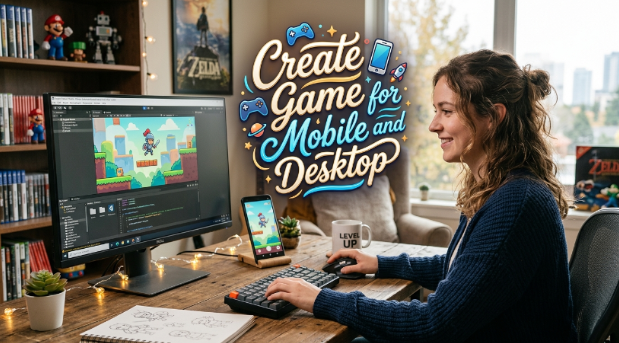
Create a Game for Mobile and Desktop

Have you ever come up with a fantastic game concept and just knew it would be great if people could play it on their mobile phones and desktop computers? You are not alone. Many people want to make a game that gets into more people’s hands, but they haven’t quite figured out how to make it work on different rigs. Platforms like Astrocade, a gaming platform designed to make game creation and play more accessible, are also helping creators explore new ways to bring their game ideas to a wider audience.
But it’s not all bad news; in fact, making a cross-platform* game isn’t nearly as hard as it once was. Whether you’re starting out as a young creator or a seasoned maker, you can make one game that runs on many devices. This book will show you how to select the right platform for your game, including options such as Astrocade, design stunning art, deliver smooth gameplay, test your game, and publish it successfully.
Choose Right Platform
The first step is to choose a game development platform that lets you create games for mobile and desktop. Many game engines now let you develop a single project and export it for multiple platforms. It’s the time saving and organizational aspect.
Before you start, look into the features of each platform. Look for simple editing tools, cross platform capabilities, asset stores and straightforward publishing. Selecting the right platform sets your project up for success.
See also: Speech Therapy in Ellenwood: Enhancing Communication Skills for Life
Design Game Graphics
Bright and fun graphics invite players to play your game from the start. When you want to Make a Game that shines, employ clear characters, colorful backgrounds and menus you can read. A clean interface increases the enjoyment of the player as a whole.
Include the same style of art throughout your level design. Ensure all buttons, icons, screens, and animations adhere to the same visual quality on desktop (large monitor/ small monitor) and on mobile (iPhone/iPhone Plus/ iPhone X/ iPhone XS/ iPhone XR/ iPad/ iPad Pro). With responsive design your game will look and play its best on all devices — phones, tablets and desktops.
Build Smooth Gameplay
Gameplays are core to the success of the game. 通:Design a simple control scheme that works for both touchscreens and keyboards. Controls need to be straightforward and intuitive so players can pick up on them while in the heat of the battle and jump straight into gameplay.
Ease the game difficulty by removing for example starting easy levels with boost projectiles. Introduce rewards, achievements, interesting missions to have players engaged even after replaying.
Test Every Device
Playing your game on multiple devices allows you to catch issues early. Test the screen size, controls, speed of loading and performance using several different models of phone, tablet, laptop and desktop pc.
Invite friends or beta testers to play your game on different devices. Their feedback will allow you to find bugs, improve controls and smooth the play for everyone.
Publish Your Game
After you’ve finished testing, it’s time to get your game ready for release. Most game development platforms allow you to export your project to websites, app stores and desktop marketplaces from a single project.
And after release, you need to keep on making your game better, by fixing bugs, and responding to player feedback. Constantly updating your app will keep your fan base engaged and potentially attract more users over time.
Conclusion
It’s never been simpler to make a game for mobile and desktop with the tools you already have today. By selecting the best platform, creating interesting visuals, programming enjoyable gameplay, and testing your game on multiple platforms, you can reach more users. Time-wise, cross-platform game development is beneficial, and users experience a smoother journey. If you’re aiming to create a game like Narwhal-io, these principles can help you build an engaging experience that works well across different devices.
One or two good releases do not guarantee success. Carry on refining the gameplay based on player feedback, and add new content over the years. Each update helps you grow as a developer and makes players a little happier to come back. With a little creativity and the desire to keep going, you can make games people want to play, regardless of what device they’re on.
Frequently Asked Questions
Can I create one game for both mobile and desktop?
Yes. Most game engines let you create a single project and then export to mobile and desktop.
Do I need coding skills to create a cross-platform game?
Is this how it will always be? Many low-code/no-code game-making platforms come with drag-and-drop functionality that simplifies making games for various platforms.
Why is testing on different devices important?
Testing ensures your game works properly on different screen sizes, operating systems, and hardware, so you can deliver a better experience to everyone who plays.
Which types of games work well on both mobile and desktop?
Typical genres for cross-platform development include puzzles, adventures, platformers, simulators, educational, and strategy games.
How can I publish my game after development?
Export your game to the app store, game site, desktop market, or your own website in just a few clicks most game engines allow.